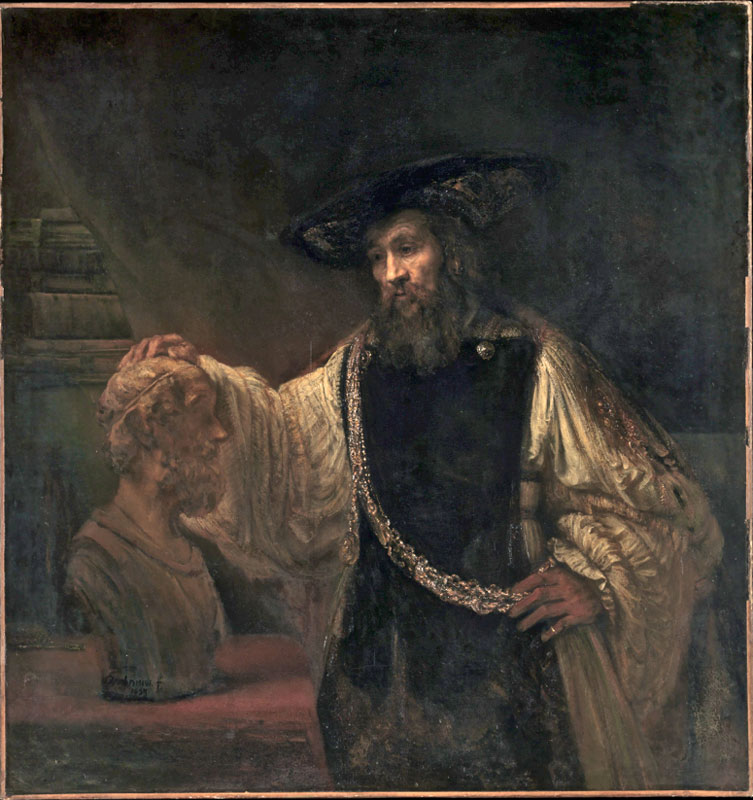
“Ac ne forte roges quo me duce, quo lare tuter,
nullius addictus iurare in verba magistri
quo me cumque rapit tempestas deferor hospes”
– Horace
And should you ask who leads, who shelters me –
I have no master whom I owe my oath
But where the wind me blows I lodge as guest.
Camus notes somewhere, “What distinguishes modern sensibility from classical sensibility is that the latter thrives on moral problems and the former on metaphysical problems.” True enough; yet the difference between traditional and modern philosophy is not that the modern addresses ethical issues, the traditional metaphysical issues. The difference is that the new thrives on human issues, the old on extra-human issues. Aristotle’s ethics were about the things a man devotes himself to and Berkeley’s metaphysics about way things are. Against these stand Nietzsche’s ethics about the things a man can make of himself and Popper’s answers to the things we cannot know.
It is easy to say something like that and easy to be wrong about it. There may be better ways of looking at it. For instance, like this. From Descartes to Kant the reigning sovereign of philosophy was system. Kant is often seen as the synthesiser of rationalism with empiricism; the systematiser of the systems and the padlock on systematisation. Hegel, of course, came after him, as did Schopenhauer and many others with comprehensive schemes of philosophy. Nevertheless, the majority of great philosophers after him are somehow different. Philosophies of ethics detatched from metaphysics arose – existentialism, utilitarianism, feminism. Those still dealing with metaphysics turned to modest logical analysts who not only claimed to conclude nothing without justification, but often really did, and so limited themselves to monographs. Those attempting to deal with the philosophy of everything took a more modest approach than had been taken in the past.
Perhaps all this is not quite adequate, perhaps it is even somewhat inaccurate. The problem that arises from it is more important to us. What are we to do with the old philosophers? They failed (according to our modern sensibility) to realise their limitations. They rushed headlong into grand schemes, which no one now could believe. Most modern philosophers know better than to do that. So what are we to do with the old philosophers?
I am not satisfied with the answer that Plato would be a genius even if he was wrong. For one thing, he sought truth, and it would be condescending to call him a genius if he didn’t find it. He wouldn’t approve. Better to say he was a noble lover of wisdom but misguided. Naturally, however, there are greater problems. Modern philosophy may have refuted Plato – and all the others, but for now we shall stick with Plato. But Plato also refuted modern philosophy. That must not be forgotten. Plato advances a proof; Modern philosophy advances a counter-proof. They are at loggerheads. Modern philosophers have the advantage which the second speaker always has: they can add refutations of Plato. But surely we must seek to counter this and, being fair to Plato’s point of view, seek out refutations on his side? And when we decide the truth, it is Plato against the moderns, ourselves judging, rather than us moderns against Plato. This is crucial. We must not automatically side with the moderns. And consider the implications of such a contest: they cannot compete unless they offer the same kinds of thing. Most twentieth century philosophers become famous for offering philosophies of the details of the universe – semantics, politics, social causes – while most old philosophers became famous for offering philosophies of the great system itself. But if we are to judge all philosophers fairly, we must judge Plato by the details as well as the system of his philosophy, and Russel by his system (Atheism and the whole complex that makes up the modern mind) as well as by its details.
Not that, at the broad view, I think Plato or Aristotle, or indeed Descartes or Spinoza or Kant, much convincing. (I do find Berkeley convincing even on the surface, but that is of little import and can be saved for another time.) But nor am I an existentialist, or a positivist, or a phenomenologist either! So if they are all wrong, in the big picture, why should the moderns be more right than the ancients? The moderns get more facts right – the facts of the details of the universe, that is – but they do not always have more wisdom than the ancients – for philosophy deals with wisdom as well as knowledge.
It might be sensible for me to conclude along the lines of ‘they all got some things right and some things wrong; we can learn from all of them and must keep our minds open.’ If so, I see no reason to be sensible. No; a platitude should never conclude. Platitudes are beginnings. So then, rather, what can we learn from each? The great schemes are often true; they are tangles of true words and in many cases agree no matter how much they try to contradict each other; nevertheless, they are not mere truisms. “All is flux” – “All is changeless”. Both are true, but they refer to different things. Neither is what it at first pretended to be. Prime matter, which Berkeley declares nonexistent, was actually declared nonexistent by the scholastics who invented it, when they said it had no qualities at all. Berkeley calls the absence of qualities nonexistence, but they did not; so they differed.
In the end, we must each construct our own philosophy, and the old philosophers, as implausible as they may be in profile, are as rich sources of philosophy as the new. There are moderns who seem to merely write commentaries on the apothegms of Protagoras and Democritus. So long as we look for apothegms in those presocratics, then, and commentaries in the moderns, we may use both. If Spinoza was wrong about thought being merely another form of the things thought about as Spirit is another form of Body, then at any rate he sets an agenda in our philosophy – why was he wrong, and what is the truth of the matter? And every time a chain of reasoning which is faultless leads to a conclusion that we find we can refute, in any philosopher, we must look to the usage of words. But it would be ridiculous to claim that all grand reasonings are verbal fallacies, because, as it is often said, only a grand reasoning could lead to such a conclusion.
None of the ancients would have told me about ‘the numinous’ or about ‘sense and reference’. But the thought of traditional philosophers are excellent case studies in both. Moreover, the grand systems and sweeping claims they made provide an aegis for their insights. We learn best about detachment and patience from the Stoa; there it is taught the clearer because it is exaggerated to erroneous proportions. Would they have learned any of the things they teach us if they had not rejected the erroneous philosophy of their culture (paganism) for their own erroneous philosophy (stoicism)? The same is true for individuals who wrote their own systems.
We still have schools – there have always been schools in philosophy – though we lack the individuals who make up the bulk of traditional philosophy. It is easier to believe that a grand scheme is right because the majority of philosophers believe it, than it would be if one had invented it oneself. And fair enough: the majority of philosophers are safer than lone philosophers; if they err, they will not err quite so widely, or at any rate, not in quite so ludicrous a way. But even a widely accepted grand scheme can be wrong. Every all-embracing scheme that is false must be translated to apply to only a small segment of reality (or none at all), while we also dig around beneath its shade for the piecemeal wisdom of its disciples.
Another reason for reading the old philosophers is that their ideas are more compact than those who came after them. The first empiricists had a somewhat simpler empiricism than those who later learned from them.
Incidentally, the greatest contributors to our own philosophies are often found wandering far from the beaten road of the philosophical tradition. To my own mind Thomas Browne, Samuel Johnson, Cicero, Vico, Dumas, Horace and the Norse sagamen could all very well claim to be philosophers.
 theparsnipoftime