The Philosophy of Trees

R.J. Brummer was the man who invented the wheel. When asked about his invention by neolithic Egyptian ambassadors, Rugu Je-magk is said to have replied, “eknæfi ‘ni huknu-puki, čvilyað hummer’ mĕn hapt Djafi Metumophem. En fēãŋ, ded’ šlakkher aüei; en q’ perittiom”: ‘We stand on the shoulders of very tall people [lit. “the short among the gods”], and my work owes its entirety to the publications of Djafi Metumophem. He will always be the first and greatest of inventors, to my mind, [because] he is the [one who discovered] trees.’

Trees are very versatile, to be sure; and though, perhaps, neolithic pseudopreprotoindoeuropean must have had a very loose definition of ‘inventor’ to apply it to the good Djafi, we surely owe him some thanks. And since we have undertaken to offer an unsystematic explanation for what will hopefully amount to almost a visible fraction of everything, we cannot neglect trees.

Maybe the most interesting use of trees is to supply the deficiency of personalities. This may sound surprising. The personification of trees goes back at least to the ancient Greeks (dryads) and rattles along just the same today. Some people remind one of trees. Like other striking personalities, these people are useful models for fiction writers and poets. But far better, if trees are what you’re going for, are actual trees, like ents or dryads. If you want something with all the forest qualities, damp and leafy and covered in bark, gregarious but quiet, why not replace human beings with dendric beings and people with trees?

Then again, trees act as a kind of barometer for city-pressure. Aside from such massive aberrations as deserts, the amount of trees indicates how urban the landscape is. The innermost part of the city has no trees, the least developed and the most remote places have many trees. You can further estimate how liveable a city is by how many trees it is fortunate enough to have. A city that has grown quickly and can offer only the minimum space to each individual has very few trees indeed. It is the cities that have had time to organise themselves that do have trees, and it is certainly more pleasant to live in a city with trees. These are the cities that have withstood and absorbed the city-pressure, hence they give a low reading on the tree barometer.

Trees provide us with homes, as many of us as have taken to permanent arboreal residences. Like the ewoks, like Cosimo di Rondò too, their livelihood hangs pendant from the branches. They of all people know best how daedal trees are. They know how dead trees provide firewood, how broad trees provide shelter, how bendy trees provide rocking chairs, how big-leaved trees in rainy places provide showers, how long thin trees provide postal catapults.

Of course, many other houses use wood as well, and you may be aware that trees are also used for paper, furniture, food, textiles, and fuel, as well as a vast variety of other commodities. And of course, they are pleasant to be around. But there is hardly time to complete this brief taste of arboreal technology, and we must hasten to the scrutiny of our next topic.

Stoicism

We should like to embark upon a comprehensive, but unsystematic, explanation for… a lot of things. And we shall start with stoicism.

But many people do not like stoicism. It is fair to say it shows a rather ridiculous face. You can swallow your anger, but it seldom goes down well. So the Stoic Face has it’s mouth full and firmly sealed and a look of pained endurance. Most people, which here means, the sensible majority, would just spit it out and get it over with.

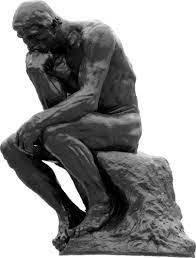
When the Stoic Face can hold it in no longer, rather a scene follows. But it is not a stoic scene. Actually, the real stoics disapproved of the whole ordeal, the full mouth, the strained endurance and the final upshot. The real stoics preferred chewing emotions up thoroughly before any attempt is made to swallow. Thus we have the Stoic Posture: head bowed, pacing back and forth, with philosophic gesticulations and much stroking of the beard. He will progress through a series of complicated fallacies to the conclusion that nothing matters, that it is not worth crying over spilt milk (by which he means, the most terrible disasters that can happen in or out of life), and above all, that it is a most serious error to ever feel any emotion about anything. He is rather wrong; if there is never any good reason for me to feel sad, then it is an exceedingly interesting and highly significant fact that I do feel sad anyway. If he wants to be logical, let him be logical. But let him not deny the facts.

Such are my gripes with stoicism. Nevertheless, I think it is among the most philosophical philosophies, when handled by a true philosopher. If you can, like the Roman Seneca, be a thoroughgoing Stoic and enjoy poetry, then you are probably on the right track. A proper stoic may not even call themself a stoic, and should certainly realise that there is no need to call themself a stoic. Reasonableness is the chief virtue of stoicism. It consists in subjecting daily life to scrutiny and making pragmatic choices. Crying over spilt milk achieves nothing and is regretted afterwards. On the other hand the only reason for the tears is the frustration of the situation. So there is no good reason to cry; besides, cleaning up the milk would remove even the urge to cry. People are making that kind of judgment all the time. But people are failing to make that kind of judgment all the time too. The sense of justice which urges one to punish the crime first and attempt to rectify it afterwards; the love of peace which urges one to break up the argument unsolved; the enthusiasm which thrusts one headlong into a catastrophe of unreadiness – all these the stoic rejects. A stoic who is genuinely reasonable rejects them not because he does not love justice, peace, and zeal, but because he does love them, and wants to take the surest means of achieving them. But I should add, a reasonable person who is genuinely a stoic thinks like that all the time.

Hence I am of the opinion that a stoic is only as good as the values they live by. Every philosopher lives by the value of reason, but it is impossible to avoid having other values too. It’s no use swallowing emotions, but to learn to set them aside while reasoning out their significance and how to achieve your goals is invaluable.

Castles and Castellans: A Debate

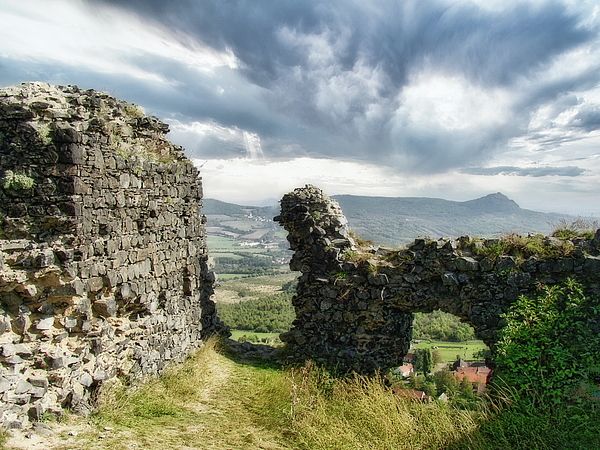
That mass of worn stone you see sitting atop the rock is a castle. It is primarily a military device, though it is unfortunately so outdated that it is not only of no use, but a positive hindrance. Hence its dereliction. It has no use.

You see the great gate of black iron? It is called a portcullis. It is also useless. Ordinarily it would open upward or fall with a crash, but this one has long since rusted into its sockets. It has not moved for centuries.

And over there, against the wall, is a little pool of water concealing a secret exit. You may notice that it is on the mountainous side. There amidst the passes and caves those who wished not to be seen could hide. The water is much higher now than it used to be, for a river has broken into the lake from above and pours itself through on its way down the cliffs. As it is now, few could stay underwater long enough to use the secret passageway.

These things are as immensely fascinating as they are useless. If you look from this angle, you can see through the ruin of the battlements to the defunct keep and the chapel. That quadrangle of grass in the chapel was a paved floor, and those great stone arches used to be hidden by roof tiles, but the villagers in the town below have needed the resources themselves over the years and this is all that remains.

Would that we could see the castle as it once was, in its days of glory! But this sad ruin is all that remains. It is but a pile of stones. It is a shadow of what it once was.

“But sir, is it not far better as it is? Is it not wondrous enough as a ruin?”

There is a story about the castellan. He made two deals, one with the king, to build the castle, one with Chance and Ruin, that they would fill up what was lacking in his labours. He died in war and was buried in an abbey graveyard far away, but his bones were brought back generations later by the last castellan, the offspring of his successor. That man was killed in war too, in a siege; the castle was pillaged, its people, routed; they fled and their descendants populate the surrounding countryside. Ruin, the story goes, began his invidious task. Most of the houses that would have lined the walls are gone, but you can see char marks and burnt timbers from the sack. The rest of the story is legend, of course.

“Very good, but if it were true, the first castellan would have shown more foresight than most, because even now few people realise that Chance and Ruin add something even as they take away.”

Maybe so, but even if the castle is more – poetic, or artistic – because it is in ruins, you must admit that it once housed and protected people, and is useless now.

“I am not sure. Look: I covered all these pages with sketches as you spoke. But I am not an artist – these are architectural sketches. If the castle is useless, it is only as useless as words or books. We are both better historians for having seen it. And I think I know – though I could not say what – I think I know a little more about humanity now that I have seen it. At any rate, it has been useful to me, so far, at least, as it has given me more to think about.”

And of course, if you ever fall in to ruin yourself, you will know the dear old lump of rock is sympathising with you. You cannot say what you have learned about humanity, but, naturally, it doesn’t occur to you to doubt that what you have learned is important. But gazing at ruins and learning is a luxury, and there are many more important things.

“But even the ‘luxuries’ that are all that is left for us once we have satisfied our own and others needs may be exercised to good effect.”

Language Learning

I am sometimes asked why anyone would learn dead classical languages. Practically the only reason that there can be is, for the books. If you would seek out what reasonable and eloquent people have to say in different places, there is no reason not to seek out what reasonable and eloquent people have to say in different tongues. In the Latin and Greek poets, the historians and philosophers, you will find humanity and wit, shrewdness and taste, as well as the folly and failings that mark men of all ages. A good language is good poetry, and good poetry in a good language is sublime. When you start reading Homer, you drink in the Greek as you learn the words and phrases, and as you progress you drink in the power of the poem itself. I have dipped in and out of various languages, dead and living, but that is always the mentality I have brought: though I might have enough philosophy in my own tongue, I can have more poetry in other tongues.

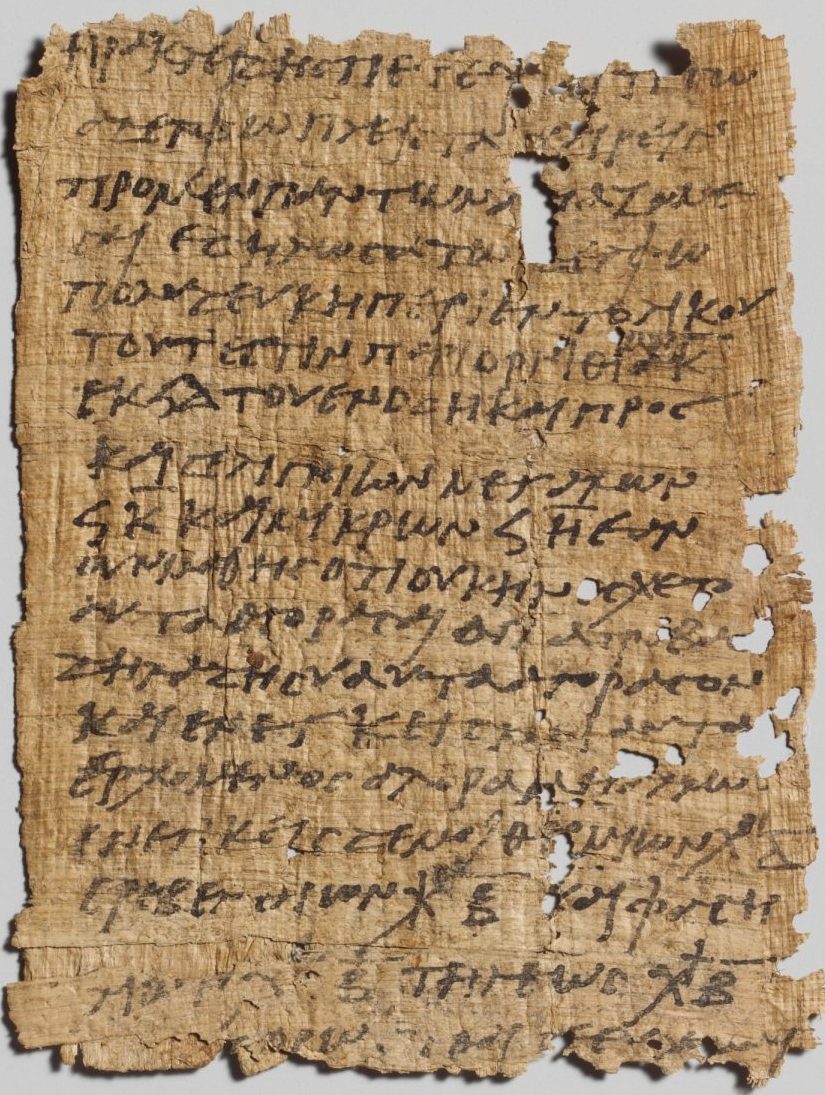
One of the greatest pleasures of reading other languages is the sight of the script itself. I could regale myself with a page of Arabic, though I could understand scarcely a word of it, simply puzzling out the phonograms and admiring the letterforms. Even before I could properly read Greek I liked the letters; when I read in the Vicar of Wakefield ‘Anarchon ara kai atelutaion to pan’ it took me a second to realise – and then I did – it was meant to be Greek, meant to be ‘ἄναρχον ἄρα καὶ ἀτελευταίον τὸ πᾶν’ – I nearly jumped out of my seat in dismay then, though I couldn’t understand half of it anyway! There was such a separation between the language and the representation, though the transcription was strictly correct and I do not think I have any rational ground for objecting to transliteration.

Some words sound natural and fitting, like the Latin ‘ruit’ with a rolled ‘r’ for ‘it collapses’, and ‘fractum’ for broken. Admittedly, many instances like this arise simply because a word in another language sounds similar to a word we use in our own language. It is always nice to recognise ‘πολύ’ (‘poly’) in Greek as ‘much’, though of course the only reason why that word should stand out is that there are many English derivatives. But why may we not enjoy such recognitions as much as genuine onomatopoeia? Of course, we must not mistake the one for the other.

Nevertheless, learning a language takes time, and when you can read a translation or bore your way through the original, it is often not only more convenient but also more enjoyable to read the translation. But the slowness of reading is amply justified by the pleasures of learning, the skills and breadth of mind gained, and the interest of coming into more direct contact with other minds that literally thought in different terms.

Aphorisms by and about Cats

The above cat is usually quite pleasant, but like all cats he is a good actor.

It may be asked, could any human being be happy living as a cat does, devoting their whole time to meticulously satisfying the necessities of life? But it may be answered that no one ever has.

The cat perceives no distinction between felinity and felicity, but any human can. This works very well for a cat, who does not care what a human might think.

Cats are the best animals to read with, because they are so often either sleeping or behaving as bibliophiles do.

“At any rate, I am intelligent enough to put up the appearance of intelligence.”

“I like four things: food, hunting, sleeping, and being served. I do all of them very well, though sometimes the last needs a bit of forcing.”

“The greatest misery I can imagine is being a human being or a pipe-cleaner.”

Cats are never impatient. They can meow for hours if need be.

There is a system of virtue specific to cats. Being pleased takes the place of our gratitude, and doing things convenient to others takes the place of our selflessness. But cats have a more cosmic philosophy of the true good. ‘It is more important,’ they think, ‘for things to go well and individuals to get what they want, than it is for me, one mere cat, to be a good cat. Thus it is far more significant for me to get my food on time than for me to express pleasure at getting it.’

“The older I get, the more I come to understand the great truth that underlies feline nature: instincts exist not so that we can fulfill them, but so that we ask humans to provide for them.” – scholium: “It does not actually matter whether I eat the food or not – the purpose of my hunger is fulfilled the moment the human gives me the food.”

Concluding contribution from the author’s cat – “I am actually quite happy now that you have finally realised that I was meowing at the door to signify that I wanted to go to sleep. We cats use symbolic language quite as well as you do!”

Entourage

Nero was a murderer because he did not understand life. His mother was a murderer before him, and apparently the deaths which secured his reign were perpetrated without or even against his will. So? He was surrounded by evil. Not just murder, either – debauchery, lust, torture… I say Nero could murder because he did not understand life. If, for Nero, the image of life he saw in his companions was to live sensually, to glut oneself, if for Nero one man could cruelly cut down another before his eyes, is it any wonder that he did not value life? How could he sympathetically understand the importance of life to others? His own he only held onto because (as someone once said) people gain the habit of living much sooner than they start to reason about whether they should or not.

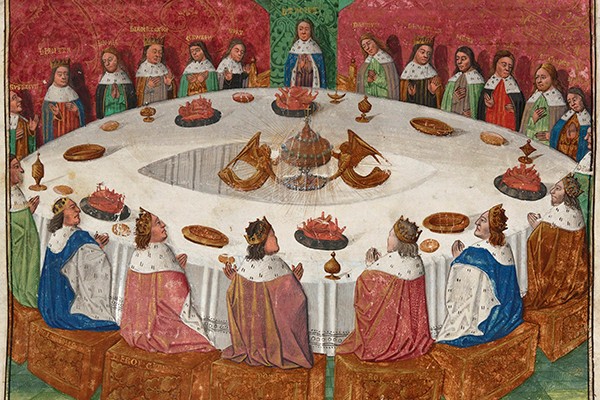
It is often said of the Round Table that its circularity signifies equality, but according to Mallory, the table was round to signify the unity of virtue. One vice in Nero lead to another. But true virtue goes together. As Erasmus said, “if a person, like a true Christian, detests one vice, he must, like a true Christian, detest all of them.” But it is equally important to note that the round table was not a symbol, it was a physical table. The pursuit of this unity of virtue was a communal thing. Nero in fellowship with the debauched lead himself into all kinds of evils. The knights in fellowship with the brave lead themselves to all kinds of good. As a comrade to the good, not only do you give yourself the opportunity to do good to them, you also give yourself the opportunity to see good done by them – a useful lesson for yourself. That is why the Bible, Old and New Testaments, so emphatically encourages meeting.

The moral to draw from these two examples is that one must surround oneself with the right kind of people. It may be that there will be few such people; it may be that you will spend your life riding alone like Arthur’s knights, only returning to fellowship as to a lodging place. It should certainly be the case that you live as much among bad company as among good, though your home is among the good.

But there is something more to be learnt. Modern thought is saliently scientific, and we forget that most of our conclusions are not reached scientifically. Our views on the world are constructed on our view of man. If we live in wretchedness and human suffering, we think of the world as a wretched place. If we live among the noble, we believe more readily in Nobility in the abstract.

That is why the Apostles Creed affirms belief in ‘the holy catholic church’. It is vital for Christians to believe what the church has always taught. But it is also important for them to know the living church and to have friendships within the church. Although we believe on the testimony of Christ and his apostles that the way of life they call us to is the truth, it is easy to doubt unless we continually see that life – in other Christians.

Camaraderie of the right kind is as essential to our beliefs and thoughts as it is to our behaviour.

The Tragedy of Pessimism

Charge: a fretful turn of mind and attempted pessimism. Defendant pleads guilty.

Defendant: “It is hard, yes, insuperably hard to be a good pessimist. You might as well not try.

“A pessimist should be bitter; pessimism is a bitter creed. A pessimist should despise hope, not because it is worthless, but because it is meaningless. A pessimist, I say, should be rational, high-minded and grave, for a pessimist should respect his creed, he should believe it and defend it! But such is so seldom the case. How hard it is for a mortal man to be a good pessimist!

“It is easy to always predict the worst, but the worst so seldom comes. “The dinner will burn, the shower will break, the cat will die!” clamours the ordinary pessimist, amidst his ordinary, uneventful life. Very little of it actually occurs. When it does occur, what does he do? Shrug his shoulders like a philosopher and say, ‘the worst is yet to come’? Take note, calculate the frequency of such events, to aid his future predictions? Yes, he shrugs alright, and he forebodes, but he means nothing of it. The mishap means everything to him – it comforts his heart – he gloats – he actually takes joy in the success of his prophecy! He calculates too, but always on this principle: a mishap once, a mishap always.

“The truth is, he is hopelessly optimistic. He thinks he can go about predicting every possible ill, and that everything will bow to his narrative. If he is right once a week, he is satisfied that he knows the truth about the universe – or rather, about toasters and showers. Ha! The truth is bitter. The world is not so kind to the pessimist as to be genuinely, unremittingly evil. And when things do go wrong, the poor pessimist has unwittingly deprived himself of the very thing he aspired to: the ability to suffer. He can only acquiesce in evil; it is nothing to him. He loses nothing good because he expects nothing good. The optimist suffers more.

“But the very fact that pessimists have descended to such expedients is a cause of shame and embarrassment to me. Noble, hard-won pessimism asserts that the toaster can break if it wishes, or not, if it doesn’t, and none of it matters. A working toaster is as bitter a fact as a broken one. ‘For the days are evil’.

“But if the world is evil, if there is a demon for a God, what would it matter? Evil would no longer be bad; it would simply be true. What reason would we have to complain? We would have no values – or we would have the wrong ones. The only way to true, deep pessimism is to believe in a good God and believe there is no hope since he has failed. But I do not believe that.

“So I come at last to acid truth: petty pessimism is petty, deep pessimism is not deep. And there go some of the best things in life! The Norse warrior, dying with his back to the mountain, hopeless, laughing, taken for his heroism to Valhalla, so that he might die once more at the End of the World – horrible, isn’t it? Yet how noble! That man sought honour for honour’s sake, not even so that he could enjoy it. Yet he was wrong. And the mystery of all it is that even if he was right, the truth is, he laughed: this, the icon of pessimism, was not a pessimist. He knew he had the best lot by far. He was happy, for he would gain his heart’s desire.

“Pessimism is doomed, and that is a tragedy.

“I have failed. I no longer care what my sentence is.”

As I listened to this trial, I felt deeply moved. I think this man has grasped something very deep. I reflected, puzzled, that Christianity is marvelously optimistic – it claims that the Highest Power will make all things good and offers goodness freely to all. But the nobility of the Norseman has not been lost. More noble was Christ, who wept, who sweated great drops like blood, praying that that his cup might be removed, knowing for what purpose he had come.

Observations on Prayer

We do not pray because prayer is psychologically beneficial, we pray because God hears prayers. Yet prayer is psychologically beneficial. Through it we express, and therefore strengthen, our emotions toward God and toward all the things we pray about – the church, the world, the creation and ourselves. Prayer is also intensely rational. You learn things while praying. These are psychological processes that can go on very well even in those who do not pray. But by praying we submit those psychological processes to God, for him to guide them and bring them to good effect.

But there is far more than that in prayer. We pray because it is good for us to praise God, since we were created to do so. We pray because we believe in a God who determines the decisions of chance, and even works miracles to glorify his name.

Naturally it is very important that we pray. Living by faith means that we must pray about all things, or at least all kinds of things. So many of us are often in the position this hymn describes –

O what peace we often forfeit,
O what needless pain we bear,
all because we do not carry
everything to God in prayer!

The Gospel teaches that Christ gives us every spiritual blessing; but before that it teaches that he takes away every spiritual evil. If we want to be content in all circumstances, we must first learn to pray in all circumstances. If we are dissatisfied with the way things are, we must turn to God.

We must allow time for prayer. Very few people pray for hours at a time; some people pray for an hour. Length, is, of course, only as good as the prayers that fill it; but if I feel a time constraint, or am conscious of what I must do after I pray, I will be less likely to pray all that I need to pray. It has helped some to sort out for themselves a time somewhat longer than they usually pray for; when I am in the habit of praying for five minutes, I allow myself half an hour for prayer and thought and reading, and rarely feel the time drag on as I often dread it may.

William Law, a protestant, recommends praying multiple times a day – at the so-called ‘hours of prayer’ (on waking, at 9:00, at noon, at 3:00, at 6:00 and before bed) – and setting a different topic for each prayer – submission for this one, thanksgiving for that one, supplication for another – as a minimum stipulation, allowing, of course, for anything else on your mind. Brother Lawrence speaks of continual prayer; he first spent a decent amount of time cementing in his mind the impression of God; after that he acknowledges that his prayer often consisted in a simple sense of God’s presence. Those who feel the need to think and reason more cannot achieve a practice identical to his, though they can certainly come near to it. At any rate, neither Law’s practice nor Lawrence’s will spontaneously attach itself to a believer, and if we desire to emulate them, we must make reasonable attempts and discipline ourselves.

William Law also recommends reading a psalm aloud before praying, particularly chanting it. Without a doubt this helps to focus and direct our minds and hearts, although personally I have found reading with expression more beneficial than chanting. A wise Christian once recommended keeping a prayer book or a hymn book for use in private devotions.

It is important, I think, for humans to think clearly, as important for the Atheist and the Muslim and the Hindu as for the Christian. It is simply because we are humans that we should be rational, for so God has designed us. And although cleverness in not a fundamental Christian virtue, it is to be commended and sought after. “The true Christian is in no way inferior to the unbeliever,” said Lloyd Jones, meaning in particular that he is no less commonsensical, and Paul says, “let your reasonableness be known to all.” Prayer, being a discourse, is a particular point where this comes into play. We must be rational when we pray. Spurgeon, in one of his sermons, exhorts us to reason with God in our prayers, making our request and reminding God of his promises, his principles, and the reasons he has taught us as to why he should grant our particular prayers. God does not need this, but it is very good for us, for when we are both wise and honest it will direct our prayers into the sure paths of God’s good will, besides strengthening our faith.

Similarly, I have observed that it helps us greatly to at least begin our prayers where our emotions and reason suggest to us. Those who struggle against certain sins, to give one example, may be put in the right frame of mind by praying for those who struggle with the same sins. It is easier to pray for those you know well than for abstract groups of people. Reason out what you will pray for.

Praying about prayer when you do not want to pray, or are distracted, is a good way of allowing God to pilot your thoughts once more.

The Lord’s Prayer is a good map for those lost in the middle of their prayers, wanting to pray for longer but forgetting what they should pray about.

Paul tells us what he prays about at the beginnings of his epistles; study these to learn what to pray for.

Prayer is, in a sense, a complete image of the Christian life. It is perhaps the most characteristic virtue of the Christian. It is often said that faith is more than mere ‘head knowledge’; that is true, for true faith is knowledge that brings forth praise and prayer. Love is the foundation of prayer – love of God and love of others. Hope is the fuel of our praise. Through prayer we receive and through prayer we express the Spirit of Christ.

A Paean to Pseudo-Science

This idea is long become stale, that there are ‘humanities’ minds and ‘science’ minds. It needs some reworking. Such a distinction has not always been made, and even now that it is made, it is not always applicable. Nevertheless, if there should be a divide, I am land the humanities side.

But there is a kind of science that can only be practiced by those with an ‘arts’ turn of mind. Ironic we would be if we called it ‘pseudo-science’ – but then, we shall be ironic. Pseudo-science is the rational attempt to make sense of the world as we observe it using primarily reason and such equipment as exists in our minds. It is therefore the contrary of science, which makes sense of the world by experiment and further observation.

To give a very basic example, we observe that the moon always shows us the same face, though it is variously shaded at different times of the month. The scientific method would proscribe a mathematical calculation of the rate at which the moon spins, conduct a series of observations and perhaps recreate the situation in a lab and draw its conclusions therefrom. The pseudo-scientific method, on the other hand, proscribes philosophical analysis along the following lines. The chances of the moon fortuitously always presenting us with the same face are so small as to be negligible. Yet we know that it does, and so it must do so for a reason. It is already known that the heavenly bodies obey the same laws as the earthly, though on a greater scale; for instance, gravity on earth draws French aristocrats’ eyes down their noses, but in space it draws planets into orbit. The closest parallels we have on earth to our lunar phenomenon are (a) two objects tied by a string, which when whirled always face each other in the same way; and (b) double-sided fridge magnets, which are only attracted to the fridge on one side. Now, no string is observed to attach to the earth, and indeed it would be impossible, for such a string would knock pedestrians off their footpaths, which does not happen. Ergo, the moon must be a giant magnet, with either the positive side facing earth’s negative side, or the negative side facing earth’s positive. A neat bit of reasoning, and thoroughly unscientific.

In fact, pseudo-science predates science. Thales, who went spouting so-called ‘nonsense’ about all being water and rocks having souls, was not, as is often said, the fathers of science, but if anything the father of pseudo-science. Actually, it predates even him, but he is the first convenient name we can latch onto. The history of science was mingled with the history of pseudo-science until relatively recently: one can see this by simply looking at all the big names. Pythagoras, who had a theorem (as did many others), also had the notion that there are 183 worlds, arranged in a triangle. His proof is lacking, but doubtless it was of a similar kind to his proof that respiration is a prerequisite for life – which he never claimed wasn’t obvious; after all, it’s all common sense and reason, isn’t it? Plato encouraged his disciples to study the heavens geometrically, but he also figured that the planets must make huge sounds, since they are so big and move so fast, and dabbled in reasoning out the explanation for why we can’t hear them. His best answer was that it is because they make a harmonious music which our ears are so accustomed to that they no longer hear it. Ptolemy with the aid of pseudo-science rejected the notion that the earth goes around the sun, and still made good astronomical calendars which were much appreciated.

Do you think this pseudo-science was a thing of the ancients? It was not. Galileo himself was a pseudo-scientist as well as a scientist. He knew, as all sensible people know, that the planets whiz around the sun in circles; he owed this idea to Copernicus. Johannes Kepler was not a sensible person, he was a scientist, so he decided that if the facts suggested that the planets go in ellipses around the sun, then that is what they do. But Galileo would not take it; his planets would have circles. Tycho Brahe, another scientist of note, had his own irrefutable and whimsically beautiful theory of the heavens: all the planets go around the sun, except the earth, which the sun itself goes around. Meanwhile, all these thinkers have added quite a bit more empiricism to their pseudo-science than their ancient predecessors. But they have not entirely relinquished the glorious heritage of pseudo-science.

Descartes is the last great pseudo-scientist, and those who wish for a clear and detailed example should study his cosmological views. Be careful, though, not to confuse pseudo-science with bad science. These are not mistaken experimental conclusions, though some of them are mistaken applications of Occam’s razor. Galileo thought the planets had circular orbits not because he made observations that mislead him into so thinking, but because he did not make observations, letting his reason run away with him. That is the glory of pseudo-science: the clear air of misguided rationalism.

Pseudo-science, which gives as much meaning to phenomena as science ever did, with not a fraction of the lab-coats and goggles! Safer, clearer, indubitable in the extreme – indubitable as only pure reason can be! Here is no less labour, no less intellectual humility, no less zeal for understanding than any scientist can offer, and far more interest, immediacy and illumination! Here is the poetry of the world, where science offers us its mechanics. Here is something as great as myth and fiction; greater, perhaps. For fiction tells us the history of worlds greater than ours, while pseudo-science tells us their natures; and while fiction does not pretend to reality, it is the pride of pseudo-science to arrogate itself to our own world, while its practitioners still admit, as humbly as anyone, that they could be wrong.

You will easily see, then, why pseudo-science exists at all. A world with no poetry to it is unappetising, so to speak, and pseudo-science, coming as it does from the human mind, has the power to make it poetic. Yes, God has made the world poetic enough, if we could only understand it truly, and every century we realise the moving power of the last century’s discoveries. But when discoveries are made, and often long after, they seem arbitrary and sometimes distasteful. And then there are the gaps which science has not answered… God alone understands fully the true poetry of the world. But anyone can understand the poetry of good pseudo-science, especially if it is convincing enough to seem true, but even, at a pinch, if it is simply make belief.

Perhaps that is why the ancient Greeks never discovered the science we now know: a world discovered by microscopes and telescopes and endless calculations was powerless to compete with their systems of simple maths, secret forces and anthropomorphic elements (that is, incidentally, a gross caricature, but it will do). Kepler and the men of his generation were only able to fully free themselves from its allure when they came to the conclusion that complex maths is poetic, or is itself poetry, so that discovering the world in formulae in no wise differs from discovering its beauty.

I hope, then, after all, it shall be clear that though I theatrically decry science, I can well admit that it has glories I do not understand, yet it should also be clear that though I have occasionally poked fun at the old ‘pseudo-scientists’, whom I admit were often (not always!) wrong, their profession certainly deserves respect and admiration. It is both noble and fun, an excellent philosophy and a wonderful joke. And if theology must supersede myth and science pseudo-science, it is not because the world is not as poetic as people have imagined it; in fact it is more so; and until we can fully understand it, perhaps even after, pseudo-science must live on with myth in our minds as we strive for truth, to remind us of that fact.
Two Kinds of Philosophy

“Ac ne forte roges quo me duce, quo lare tuter,

nullius addictus iurare in verba magistri

quo me cumque rapit tempestas deferor hospes”

– Horace

And should you ask who leads, who shelters me –

I have no master whom I owe my oath

But where the wind me blows I lodge as guest.

Camus notes somewhere, “What distinguishes modern sensibility from classical sensibility is that the latter thrives on moral problems and the former on metaphysical problems.” True enough; yet the difference between traditional and modern philosophy is not that the modern addresses ethical issues, the traditional metaphysical issues. The difference is that the new thrives on human issues, the old on extra-human issues. Aristotle’s ethics were about the things a man devotes himself to and Berkeley’s metaphysics about way things are. Against these stand Nietzsche’s ethics about the things a man can make of himself and Popper’s answers to the things we cannot know.

It is easy to say something like that and easy to be wrong about it. There may be better ways of looking at it. For instance, like this. From Descartes to Kant the reigning sovereign of philosophy was system. Kant is often seen as the synthesiser of rationalism with empiricism; the systematiser of the systems and the padlock on systematisation. Hegel, of course, came after him, as did Schopenhauer and many others with comprehensive schemes of philosophy. Nevertheless, the majority of great philosophers after him are somehow different. Philosophies of ethics detatched from metaphysics arose – existentialism, utilitarianism, feminism. Those still dealing with metaphysics turned to modest logical analysts who not only claimed to conclude nothing without justification, but often really did, and so limited themselves to monographs. Those attempting to deal with the philosophy of everything took a more modest approach than had been taken in the past.

Perhaps all this is not quite adequate, perhaps it is even somewhat inaccurate. The problem that arises from it is more important to us. What are we to do with the old philosophers? They failed (according to our modern sensibility) to realise their limitations. They rushed headlong into grand schemes, which no one now could believe. Most modern philosophers know better than to do that. So what are we to do with the old philosophers?

I am not satisfied with the answer that Plato would be a genius even if he was wrong. For one thing, he sought truth, and it would be condescending to call him a genius if he didn’t find it. He wouldn’t approve. Better to say he was a noble lover of wisdom but misguided. Naturally, however, there are greater problems. Modern philosophy may have refuted Plato – and all the others, but for now we shall stick with Plato. But Plato also refuted modern philosophy. That must not be forgotten. Plato advances a proof; Modern philosophy advances a counter-proof. They are at loggerheads. Modern philosophers have the advantage which the second speaker always has: they can add refutations of Plato. But surely we must seek to counter this and, being fair to Plato’s point of view, seek out refutations on his side? And when we decide the truth, it is Plato against the moderns, ourselves judging, rather than us moderns against Plato. This is crucial. We must not automatically side with the moderns. And consider the implications of such a contest: they cannot compete unless they offer the same kinds of thing. Most twentieth century philosophers become famous for offering philosophies of the details of the universe – semantics, politics, social causes – while most old philosophers became famous for offering philosophies of the great system itself. But if we are to judge all philosophers fairly, we must judge Plato by the details as well as the system of his philosophy, and Russel by his system (Atheism and the whole complex that makes up the modern mind) as well as by its details.

Not that, at the broad view, I think Plato or Aristotle, or indeed Descartes or Spinoza or Kant, much convincing. (I do find Berkeley convincing even on the surface, but that is of little import and can be saved for another time.) But nor am I an existentialist, or a positivist, or a phenomenologist either! So if they are all wrong, in the big picture, why should the moderns be more right than the ancients? The moderns get more facts right – the facts of the details of the universe, that is – but they do not always have more wisdom than the ancients – for philosophy deals with wisdom as well as knowledge.

It might be sensible for me to conclude along the lines of ‘they all got some things right and some things wrong; we can learn from all of them and must keep our minds open.’ If so, I see no reason to be sensible. No; a platitude should never conclude. Platitudes are beginnings. So then, rather, what can we learn from each? The great schemes are often true; they are tangles of true words and in many cases agree no matter how much they try to contradict each other; nevertheless, they are not mere truisms. “All is flux” – “All is changeless”. Both are true, but they refer to different things. Neither is what it at first pretended to be. Prime matter, which Berkeley declares nonexistent, was actually declared nonexistent by the scholastics who invented it, when they said it had no qualities at all. Berkeley calls the absence of qualities nonexistence, but they did not; so they differed.

In the end, we must each construct our own philosophy, and the old philosophers, as implausible as they may be in profile, are as rich sources of philosophy as the new. There are moderns who seem to merely write commentaries on the apothegms of Protagoras and Democritus. So long as we look for apothegms in those presocratics, then, and commentaries in the moderns, we may use both. If Spinoza was wrong about thought being merely another form of the things thought about as Spirit is another form of Body, then at any rate he sets an agenda in our philosophy – why was he wrong, and what is the truth of the matter? And every time a chain of reasoning which is faultless leads to a conclusion that we find we can refute, in any philosopher, we must look to the usage of words. But it would be ridiculous to claim that all grand reasonings are verbal fallacies, because, as it is often said, only a grand reasoning could lead to such a conclusion.

None of the ancients would have told me about ‘the numinous’ or about ‘sense and reference’. But the thought of traditional philosophers are excellent case studies in both. Moreover, the grand systems and sweeping claims they made provide an aegis for their insights. We learn best about detachment and patience from the Stoa; there it is taught the clearer because it is exaggerated to erroneous proportions. Would they have learned any of the things they teach us if they had not rejected the erroneous philosophy of their culture (paganism) for their own erroneous philosophy (stoicism)? The same is true for individuals who wrote their own systems.

We still have schools – there have always been schools in philosophy – though we lack the individuals who make up the bulk of traditional philosophy. It is easier to believe that a grand scheme is right because the majority of philosophers believe it, than it would be if one had invented it oneself. And fair enough: the majority of philosophers are safer than lone philosophers; if they err, they will not err quite so widely, or at any rate, not in quite so ludicrous a way. But even a widely accepted grand scheme can be wrong. Every all-embracing scheme that is false must be translated to apply to only a small segment of reality (or none at all), while we also dig around beneath its shade for the piecemeal wisdom of its disciples.

Another reason for reading the old philosophers is that their ideas are more compact than those who came after them. The first empiricists had a somewhat simpler empiricism than those who later learned from them.

Incidentally, the greatest contributors to our own philosophies are often found wandering far from the beaten road of the philosophical tradition. To my own mind Thomas Browne, Samuel Johnson, Cicero, Vico, Dumas, Horace and the Norse sagamen could all very well claim to be philosophers.