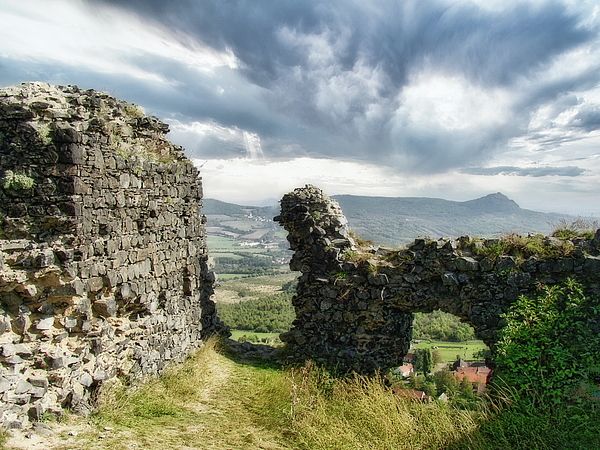
That mass of worn stone you see sitting atop the rock is a castle. It is primarily a military device, though it is unfortunately so outdated that it is not only of no use, but a positive hindrance. Hence its dereliction. It has no use.
You see the great gate of black iron? It is called a portcullis. It is also useless. Ordinarily it would open upward or fall with a crash, but this one has long since rusted into its sockets. It has not moved for centuries.
And over there, against the wall, is a little pool of water concealing a secret exit. You may notice that it is on the mountainous side. There amidst the passes and caves those who wished not to be seen could hide. The water is much higher now than it used to be, for a river has broken into the lake from above and pours itself through on its way down the cliffs. As it is now, few could stay underwater long enough to use the secret passageway.
These things are as immensely fascinating as they are useless. If you look from this angle, you can see through the ruin of the battlements to the defunct keep and the chapel. That quadrangle of grass in the chapel was a paved floor, and those great stone arches used to be hidden by roof tiles, but the villagers in the town below have needed the resources themselves over the years and this is all that remains.
Would that we could see the castle as it once was, in its days of glory! But this sad ruin is all that remains. It is but a pile of stones. It is a shadow of what it once was.
“But sir, is it not far better as it is? Is it not wondrous enough as a ruin?”
There is a story about the castellan. He made two deals, one with the king, to build the castle, one with Chance and Ruin, that they would fill up what was lacking in his labours. He died in war and was buried in an abbey graveyard far away, but his bones were brought back generations later by the last castellan, the offspring of his successor. That man was killed in war too, in a siege; the castle was pillaged, its people, routed; they fled and their descendants populate the surrounding countryside. Ruin, the story goes, began his invidious task. Most of the houses that would have lined the walls are gone, but you can see char marks and burnt timbers from the sack. The rest of the story is legend, of course.
“Very good, but if it were true, the first castellan would have shown more foresight than most, because even now few people realise that Chance and Ruin add something even as they take away.”
Maybe so, but even if the castle is more – poetic, or artistic – because it is in ruins, you must admit that it once housed and protected people, and is useless now.
“I am not sure. Look: I covered all these pages with sketches as you spoke. But I am not an artist – these are architectural sketches. If the castle is useless, it is only as useless as words or books. We are both better historians for having seen it. And I think I know – though I could not say what – I think I know a little more about humanity now that I have seen it. At any rate, it has been useful to me, so far, at least, as it has given me more to think about.”
And of course, if you ever fall in to ruin yourself, you will know the dear old lump of rock is sympathising with you. You cannot say what you have learned about humanity, but, naturally, it doesn’t occur to you to doubt that what you have learned is important. But gazing at ruins and learning is a luxury, and there are many more important things.
“But even the ‘luxuries’ that are all that is left for us once we have satisfied our own and others needs may be exercised to good effect.”
 theparsnipoftime
Methinks said castle is something of a metaphor…alone, atop the hill, with a glorious panorama of the surrounding landscape, a prime military position…it seems to, with an almighty cry, just scream: “Be Yourself”
LikeLiked by 1 person
On another note, it is a fascinating study…that of the useless. The castle, though now arguably defunct…is perhaps more interesting because it is defunct, than when it were…funct?
LikeLike
Aren’t useless things the most fascinating? That they still exist, despite their non-function, is perhaps the key to understanding them. As was said, they have much to teach us, and maybe that is why they survive past their initial purposes.
LikeLiked by 1 person